Posts in: International Cooperation

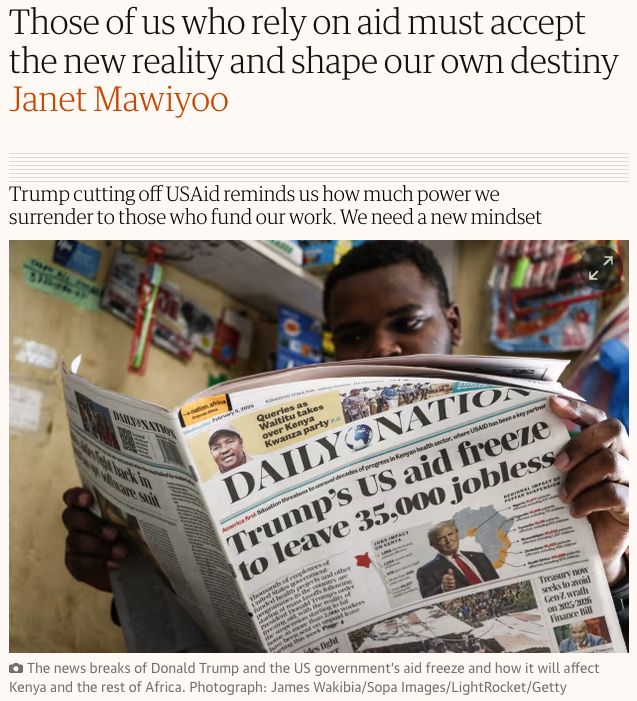
Janet Mawiyoo’s article is a timely call for reflection. She insightfully reflects on the changing landscape of international aid and urges communities to embrace self-reliance. Whatever role international cooperation can play in this, it should always and truly be the starting point for international partners in the future. #FutureOfCooperation

Full article in The Guardian: t1p.de/iybcc Janet Mawiyoo on LinkedIn: www.linkedin.com/in/jmawiy…

A person reads a newspaper with the headline about Trump's aid freeze potentially leaving 35,000 jobless.

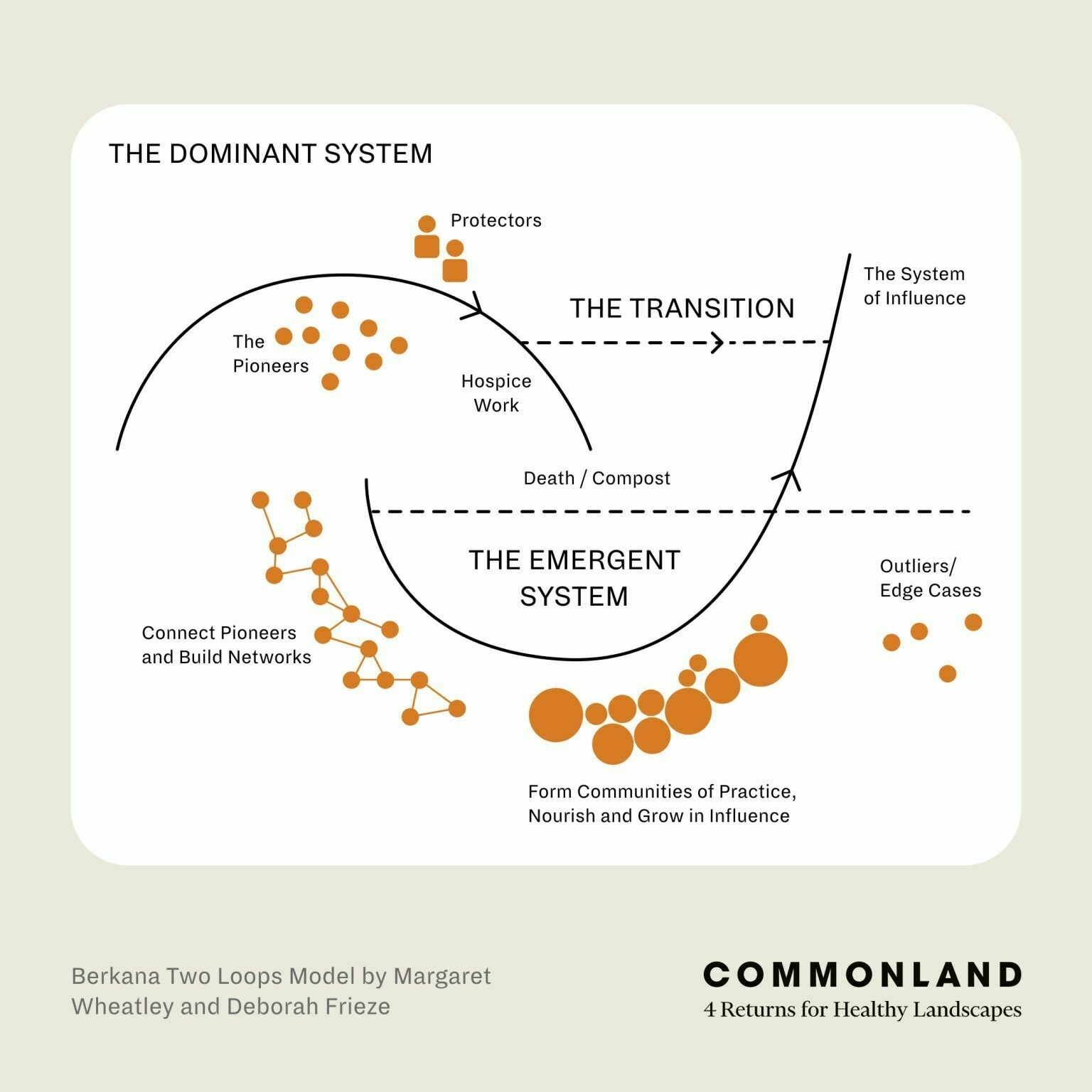
Nice visualisation of a transformation journey shared by the people of Commonland 👉 commonland.com.

Thanks to Jeremy Akers for sharing this! 👉 Jeremy Akers

It’s a stark reminder for those innovating in the global aid industry: the old system - with its vested interests - won’t just let go, even when it’s under considerable pressure. Instead, a powerful dynamic driven by positive energy needs to be created. ⚡

#FutureOfCooperation

Here’s how the change is being driven:

  • Pioneers are experimenting with new ways of thinking and doing. 🚀
  • Protectors nurture new ideas and help to phase out outdated practices. đŸŒ±
  • Community is key to sharing experiences and driving change. đŸ€

What I am personally taking away from this for my journey:

  • I’ll continue to build my pioneer bootstrapped project with passion and endurance.
  • I’m actively looking for protectors and working hard to become one myself - a strong network is essential!
  • I’m committed to networking and connecting with other pioneers to learn and grow.

So, if you’re interested, get in touch and let’s collaborate! 🚀

The Two Loops Model by Margaret Wheatley and Deborah Frieze illustrates the transition from a dominant system to an emergent system through pioneers, protectors, and community building.

The NFT craze is over, but there are still scams around, but hey - here we go: I’ve minted a NFT for a little crypto, and it’s for a good cause! 🚀 It’s for Mercy Corps Ventures' 4th Crypto For Good web3 grant programme. Mercy Corps launched the 4th round of the C4G fund in November 2024. After three rounds with over 500 applicants, 15+ pilots and 40,000+ users, their mission is to fund real-world web3 use cases that help people in the Global South access financial services and build resilience to climate change. 🌍

👉 Mercy Cops Ventures

Proud to be part of a team that’s applying to this program, using crypto to advance a cause for good. And of course I’m not getting rich off this NFT 😂 - it’s a personal token to celebrate our meaningful efforts đŸ’ĄđŸ€.

A futuristic landscape features a glowing red sun above mountains with the text Crypto for Good Fund IV and the Mercy Corps Ventures logo.

Learned about a very interesting concept of running localisation labs to introduce experimentation into the work of local actors and local NGOs. #FutureOfCooperation

Understanding that the #DevelopmentAid #HumanitarianAid industry needs to change is one thing. But it needs alternatives: One interesting approach is NEAR’s localisation labs: Launched in 2023, they empower local leaders and organisations to drive localisation by building connections and advancing shared goals through four pillars: amplifying voices, positioning local leaders, co-creating solutions, and fostering learning.

Also check out NEAR (Network for Empowered Aid Response), a movement of local and national civil society organizations from the Global South, aiming to reshape the humanitarian and development aid system into one that is locally driven, equitable, and dignified.

A stylized logo symbolizing a bouncing ball, featuring three curved orange arcs with red dots underneath, representing bounce points, and a final upward trajectory.

While claiming to address “The Elephants in the Room: Uncomfortable Perspectives on the Fourth Financing for Development (FfD) Conference” the author of the op-ed avoids confronting the real challenges of development cooperation—even arguing that ‘Innovation may have to wait.’

But can a system that has spent decades evolving into a self-referential sphere afford to delay meaningful transformation?

Despite its self-perception, the development industry has become well-funded but also rife with self-referentiality over its decades-long history as a policy field and industry. It has become highly complex, expert-driven and increasingly disconnected from both those it seeks to serve and those who ultimately fund its initiatives. As the field has evolved, it has lost sight of the fundamental that international cooperation, at its core, must be about people — thinking, reflecting, and acting for change. So, has the development industry forgotten that it is a people business?

In OECD countries development policy has long remained a niche interest. Public engagement was limited, allowing the sector to grow into a quite siloed ecosystem, without being subject to broader and more intensive social scrutiny.

Yet, skepticism was already present. Even before populist narratives gained traction, public confidence in development aid was low. In Germany, e.g., in 2017 only 10% of respondents to a survey thought it was largely effective (while 25% thought it was mainly ineffective). This sentiment did not lead to anything significant — perhaps because the system continued to function well for established players. But was it working well for the people it was meant to serve?

The sector’s top-down decision-making, rigidities, donor-driven priorities and lack of local ownership have often stifled local problem-solving and lasting positive transformation. While the humanitarian sector, for example, has addressed some of these issues through the Grand Bargain process, there has been little in the way of in-depth reactive efforts in development.

This is where innovation comes in. To move the sector forward, it must come to terms with its past. This is why the recent push by the German Federal Ministry for Economic Cooperation and Development (BMZ) to examine colonial continuities is a step forward. It would also be important to systematically increase the participation of local communities in projects. Innovative digital solutions can improve transparency, accountability and impact, while reducing the risk of corruption. To name but a few

Yet, the op-ed essentially advocates for preserving the status quo — suggesting that “Innovation may have to wait.”

So let’s address the elephant in the room. For too long, the industry has been caught in a cycle of self-reinforcement, not feeling the need for meaningful change even in the face of mounting internal and external challenges.

The question is no longer whether innovation is needed, but whether the key players have the courage to act before the industry loses even more of its reputation as a real contributor to solutions.

#FutureOfCooperation

The field of international cooperation (aka development cooperation or development aid) is currently undergoing a major shake-up.

Even though it may not be easy to tell the difference from the outside, development and humanitarian aid are quite separate in terms of processes and key players.

As a result, interesting initiatives in the humanitarian field go largely unnoticed (at least in Germany) in the international development spave. One of them is the Grand Bargain . #FutureOfCooperation

The Grand Bargain is an agreement between major donors and aid organisations, launched at the 2016 World Humanitarian Summit and updated for 2023-2026.

It aims to improve the efficiency and effectiveness of humanitarian aid through measures such as increased multi-year and flexible funding, harmonised reporting and greater transparency.

A central pillar of the Grand Bargain is its focus on localisation, which aims to bring decision-making and financial resources closer to affected communities by committing to channel at least 25% of humanitarian funding “as directly as possible” to local and national responders.

This localisation effort aims to reduce transaction costs, strengthen local capacities and ensure that humanitarian action is both responsive and context-specific, embodying the principle of making aid “as local as possible and as international as necessary”.

This could be an excellent area for exaptation (radical repurposing) if the international cooperation sector is genuinely interested in a change of its own making. Otherwise, there is a considerable risk that it will continue to be subject to (radical?) transformation.

A colorful billboard with the text The Grand Bargain stands amidst an urban setting under a blue sky.

Big shifts are shaking up the international cooperation (aka development cooperation, development aid) sector. Recent actions, with the temporary low of dismantling USAID, have highlighted the fragility of aid dependency. #FutureOfCooperation

In Duncan Green ’s post, this is the first lesson he lays out. We have probably also reached “peak aid”. He recommends looking more to local sources (and the diaspora). I would also add impact investors.

The second lesson is interesting in terms of the necessary transformation of the sector: refocusing on empowering local actors rather than directly providing services. He suggests building capacity as a kind of “public service advocates”.

Looking at the bigger picture, I think this underlines the need to empower local actors to drive their own development by demanding or building better services. By focusing more on local needs and capacities, and less on getting help from outside as a first preference, communities can become stronger and more self-sufficient.

So it’s time to rethink our approach and prioritise sustainable, locally-led solutions. đŸŒđŸ€

Read Duncan Green’s full post here: t1p.de/74kxk

tl;dr: The future of development cooperation isn’t more aid most probably — it’s more local power. 🚀🌍 Move beyond dependency and invest in stronger, self-driven communities. Time to rethink, empower, and transform! đŸ’ĄđŸ”„ #FutureOfCooperation

Seit langem gibt es eine kritische Diskussion ĂŒber die Ausgestaltung der Internationalen Zusammenarbeit (auch Entwicklungszusammenarbeit oder Entwicklungshilfe genannt). Gerade in den letzten Wochen habe ich einige dieser Punkte unter #FutureOfCooperation selbst aufgegriffen.

Bis vor kurzem verlief diese Diskussion noch ĂŒberwiegend konstruktiv, bezogen auf wesentliche Schwachstellen. Aber bewirkt hat sie - fast nichts. Zu einfach war es, in der bequemen Nische so weiterzumachen wie bisher.

Nun ist die Branche in vielen LĂ€ndern zu einer leichten Beute fĂŒr Populisten geworden.

Was in diesen Tagen in den USA einen traurigen Tiefpunkt erreicht, hat auch in einigen europĂ€ischen Staaten schon zu teilweise drastischen VerĂ€nderungen gefĂŒhrt.

Dieser populistische Furor bringt die Industrie nun in eine Situation, in der sie um ihre Rolle kÀmpfen muss.

Was bleibt unter diesen Bedingungen? Wir werden wohl eine Verengung sehen auf AktivitĂ€ten 1) mit klarem humanitĂ€rem Bezug und 2) auf die Verfolgung nationaler Interessen bzw. geopolitischer Themen. FĂŒr alles dazwischen und drumherum wird die Luft dĂŒnn.

Daher sollte es jetzt allen Verantwortlichen darum gehen, sich nun aktiv und mutig mit innovative AnsÀtze den Problemen in diesen beiden Bereichen zu stellen.

Jetzt ist es die sehr herausfordernde Aufgabe, auch unter diesen Rahmenbedingungen zĂŒgig

  • sowohl ein besserer, weil echter Partner fĂŒr die Menschen in unseren PartnerlĂ€ndern zu werden,
  • als auch ein besserer, weil schnellerer, flexiblerer und wirksamerer Partner fĂŒr die Regierungen, die weiterhin Mittel fĂŒr dieses Politikfeld bereitstellen wollen.

Das alles ist schwierig. Es wÀre einfacher gewesen, wenn es in ruhigeren Zeiten konsequent angegangen worden wÀre. Aber es ist weiter möglich.

#FutureOfCooperation

There has long been a critical debate about international cooperation (also known as development cooperation or development aid). In recent weeks in particular, I have taken up some of these points myself under #FutureOfCooperation.

Until recently, this discussion has been largely constructive, focusing on key weaknesses. But it has achieved - almost nothing. It was too easy for the industry to continue in its comfortable niche.

This inactivity has now made the sector an easy prey for populists in many countries.

What is currently reaching a sad low point in the US has already led to some drastic changes in European countries.

This populist rage is now putting the industry in a situation in which it has to fight for its role.

What remains under these conditions? We are likely to see a narrowing down to 1) activities with a clear humanitarian focus and 2) the pursuit of national interests or geopolitical issues. The air will be thin for everything in between and around these two areas.

It should therefore be a matter of urgency for all those responsible to actively and courageously tackle the problems in these two fields with a fresh perspective.

So, under these difficult conditions, the challenge now is to become both

  • a genuine partner for the people in our partner countries
  • and a much better, meaning faster and more flexible partner for the governments that continue to fund this policy area.

That is difficult. It would have been much easier if we had done it consistently in calmer times. But it is still possible.

#FutureOfCooperation

Reflections on a decade working in Development and Aid: Zahir Shah’s insightful article is a must-read for anyone in the sector, or those considering to join.

His emphasis on the distinction between immediate humanitarian aid and long-term development work is also crucial in the search for interesting approaches to development aid. Shah’s call to decolonise aid by prioritising local ownership and aligning with government strategies resonates deeply. It’s a powerful reminder that real progress requires moving beyond bureaucratic inefficiency and neo-colonial tendencies, and fostering genuine partnerships with the communities we seek to support.

Distribution of BP-5 emergency food packages by UNICEF in Goma, Democratic Republic of the Congo, in November 2008 - from Flickr, CC BY-SA 2.0