Posts in: FutureOfCooperation

🌟 Honored to have been part of workshop on “Harnessing the Potential of Digital Sustainable Finance to Accelerate the Agenda 2030” in Bonn! 🌟

A big thank you to the German Institute of Development and Sustainability (IDOS), SOAS Centre for Sustainable Finance and particularly Prof. Ulrich Volz for organising such an insightful event.

During the morning of this full-day workshop, I participated in a closed-door roundtable that explored ‚Rethinking capital market infrastructure to scale up sustainable finance‘ and ‚Fostering inclusive green finance through digital solutions‘. The presentations and discussions were enlightening with valuable contributions from Yuen Lo and Peter Knaack.

When I was on the panel after the official book launch, the panel was asked to single out the most important innovation in this area. While I made it clear how digital payments #web3 #stablecoins can really help, I specifically emphasised the huge potential of #biodiversity #certificates in dealing with the big problems we’re facing.

It was a pleasure to engage with esteemed speakers including Dr. Erica Moret, Amb. Prof. Bitange Ndemo, and Dr. Iliya Nickelt.

If you missed the live stream, the book “Sustainable Digital Finance” is available as a PDF or EPUB via open access at Springer.

#SustainableFinance #DigitalFinance #Agenda2030 #Sustainability #FinanceForGood #FutureOfCooperation
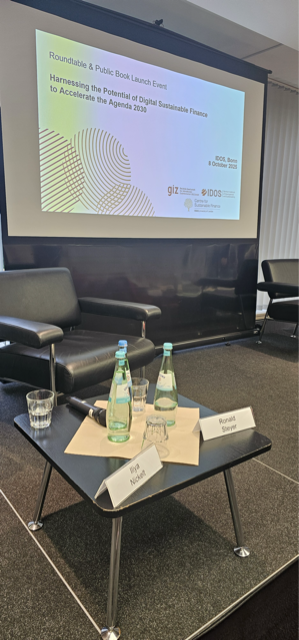
A conference setup features a screen displaying event information on digital sustainable finance, flanked by black chairs and a table with water bottles and labeled name cards.

🌐 Building Resilient Digital Transactions in Fragile Contexts with Web3 🌐

In fragile environments, secure and inclusive digital transactions can transform lives. I recently revisited the technology and economics behind these solutions and sketched out the stack required to make them work.

Why does this matter? Clarity is key—both for didactics and procurement. Explicitly breaking down the stack helps generate a common understanding, especially when discussing setup with non-technical stakeholders. It also ensures that expected services are properly defined during procurement.

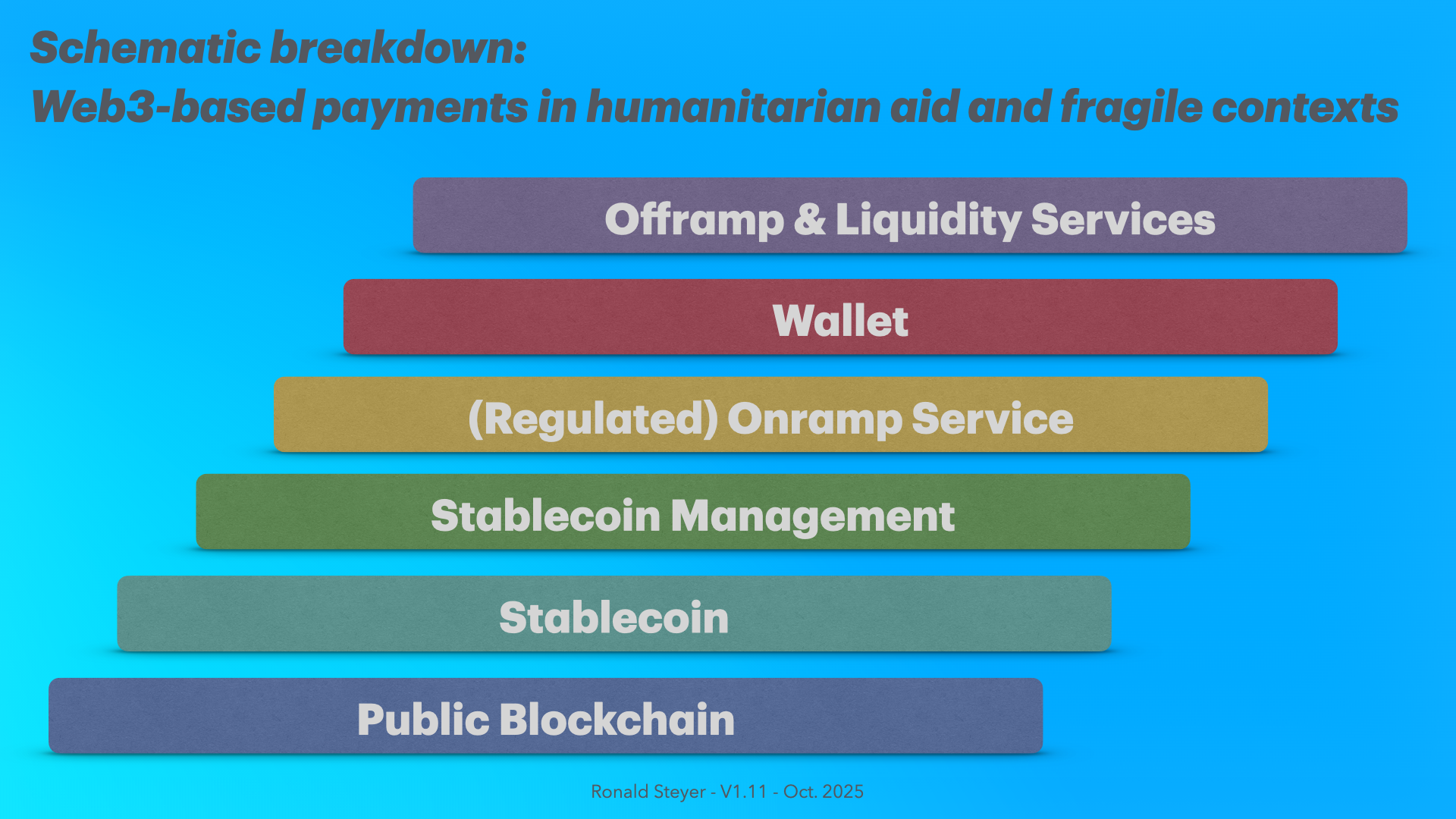
This is how I currently understand the stack to come together:

🔗 Public Blockchain layer 1/2: The foundation—like Algorand, Cosmos, Ethereum, Gnosis, Linea, Polygon, or Stellar—delivering security, transparency, and smart contract capabilities.

💰 Stablecoin: Digital currencies like USDT, USDC, and EURS, providing stability and enabling seamless cross-border transactions.

⚙️ Stablecoin Management: Platforms such as ensuring compliance and smooth integration with APIs and tools.

🔒 (Regulated) Onramp Service Provider: The regulated gateway for converting fiat to digital assets, ensuring trust and accessibility.

👛 Wallet: User-friendly digital wallets enabling secure storage and transactions, even offline.

💱 Offramp & Liquidity Services: Services bridging digital assets to local currency and ensuring liquidity, such as mobile money providers or local liquidity vendors.

This space is still evolving, with overlaps and players emerging as solution providers—integrating parts of the stack.

👉🏻 Does this resonate? Does it help you understand the space better? Do you see yourself in this stack?

🔍 TL;DR: Web3 is reshaping digital transactions in fragile contexts. From blockchain infrastructure to regulated onramps and user-friendly off-ramps, every layer matters. Does this help you? Let’s discuss! 🚀

A schematic breakdown illustrates various layers of Web3-based payments in humanitarian aid and fragile contexts, including public blockchain, stablecoins, and related services.

Stablecoins: Why the Fundamentals Matter 💰🔗

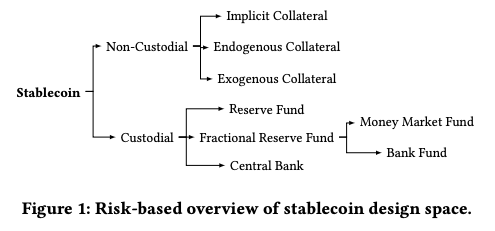
As stablecoins gain traction, especially in development and humanitarian contexts, it is worth revisiting some of the fundamental risks. The 2020 paper Stablecoins 2.0: Economic Foundations and Risk-Based Models (Klages-Mundt et al.) still serves as a timely reminder that: Not all stablecoins are created equal, and their risks are often underestimated.

For custodial stablecoins (those backed by reserve funds), three core risks stand out:

  • Counterparty risk: Your trust is only as strong as the custodian’s solvency and integrity. There is no deposit insurance here.
  • Censorship risk: Centralised control means redemptions or issuance can be blocked.
  • Economic risk: If the value of the reserve assets fluctuates, so does the value of your ‘stable’ coin. Simply being pegged does not guarantee stability.

The paper’s framework remains relevant today, particularly as institutional adoption increases. When using stablecoins in high-stakes environments such as aid or remittances, these shouldn’t be abstract concerns.

🔗 Read the paper

A risk-based overview diagram outlines the stablecoin design space, categorizing them into non-custodial and custodial types with further subdivisions.

I just recently posted about a paper describing how “Conjuring a Blockchain Pilot” worked in #HumanitarianAid in the early days of the #blockchain hype.

This article by Martine Dahl-Bastiansen published on the London School of Economics and Political Science (#LSE) website presents a variety of applications in the field.

As I am not familiar with all the projects described there, I cannot endorse them in terms of their meaningful and responsible use of blockchain technology.

So even when decentralised technology is used, many of these projects seem to continue to reflect centralised procedures. Moreover, the mere use of technology does not indicate acceptance if people have no alternative but to use the system defined by international donors.

Again: In the end, technology should not be first; it should be critically assessed, even if one is confident about the opportunities in selected use cases. And design should start with the people and communities, which the support should help to improve their living and create opportunities. #FutureOfCooperation #blockchain #web3

Read the post: How Blockchain is Contributing to the Humanitarian Sector as of 2025

🛰️ IRIS²: Europe’s Answer to Secure, Sovereign Satellite Internet

Many countries with limited telecom infrastructure are turning to satellite internet—often to Starlink. But relying on a single, geostrategically sensitive provider comes with risks: data sovereignty, dependency, and unpredictable access.

Enter IRIS², the EU’s new secure satellite constellation. Designed for resilience, interoperability, and security, IRIS² aims to provide high-speed, encrypted connectivity across Europe and beyond, especially where cables and towers fail.

Why it matters:

  • Digital sovereignty: No more reliance on non-EU providers for critical communications.
  • Multi-orbit resilience: Combines LEO and MEO satellites for low latency and global coverage.
  • Beyond broadband: Supports crisis management, healthcare, and secure government operations.
  • Future-proof: Built for 5G/6G, quantum-safe encryption, and seamless integration with terrestrial networks.

First services start in 2029, full deployment by 2030. A strategic move—not just for Europe, but for any region seeking independent, reliable connectivity.

🚀 Read more

#DigitalSovereignty #SatelliteInternet #IRIS2 #InternationalCooperation

Satellites orbiting Earth are shown connected by a network of glowing lines over a dark space background.

Blockchain based solutions in #InternationalDevelopment seem to slowly pass the trough of disillusionment, entering the slope of enlightenment, following the Cycle of Overblown Hopes and Shattered Dreams defined by a large research and advisory firm.

But that does not mean the same mechanisms may again kick in that lead to the overstated expectations of the hype phase.

In the field of humanitarian aid, the paper ‘Conjuring a Blockchain Pilot: Ignorance and Innovation in Humanitarian Aid’, describes the mechanisms that came into play during the initial hype surrounding blockchain technology. While I do not agree with all of the paper’s arguments, I believe it provides a concise description of the dynamics within the sector that is also relevant to development cooperation.

In the end, technology should not be first; it should be critically assessed, even if one is confident about the opportunities in selected use cases. And design should start with the people and communities, which the support should help to improve their living and create opportunities. #FutureOfCooperation #blockchain #web3

A vibrant and abstract explosion of colorful cosmic swirls and shapes featuring various symbols, such as Bitcoin logos, against a dark background.

Der Entwicklungssektor hat sich zu lange in einer selbstreferenziellen Blase bewegt. Er hat vor allem mit sich selbst gesprochen, seine eigene Logik bestätigt und sich gegen breitere Kritik …

In June, I shared a vision for the future of German government-funded development cooperation. The response was very positive, sparking many insightful discussions. Thank you for your engagement and valuable contributions!

Encouraged by your feedback, I am preparing a revised and refined version in German to continue this important dialogue.

My initial argument centred on the need to distinguish between different approaches to international cooperation in the German context. I proposed three pillars to focus the ministry of economic cooperation and development’s portfolio:

  • Community-based work to unlock positive economic and social dynamics - the concept that replaces the traditional „development cooperation“ approach.
  • Economic cooperation based on mutual benefit and high ethical standards.
  • Support for low-resource countries to exercise “smart sovereignty” in international governance.

I believe that separating these pillars can help better align expectations of all involved parties aligned, which helps to consistently design the modes of cooperation and processes with the different stakeholders.

However, I was also told that some of my messages could be clearer. In the first pillar, I linked the argument for creating this specific pillar with the recommendation to fundamentally change the whole concept of ‘development cooperation’. Therefore, in my revision, I will separate these elements to present a more structured argument.

Interestingly, one aspect that was agreed upon without much debate was the suggestion to focus one column on economic cooperation involving, and even promoting, German and European companies based on high ethical standards.

The most significant revisions will be made to the third pillar, which I initially proposed should focus on the fair participation of low-resource countries in international governance. I intend to expand this perspective to include a broader view covering global public goods in areas such as climate and health. As governance is also a key component there, additional elements may be required to ensure the provision of these goods. This could include financing mechanisms for global public goods, such as health and vaccination initiatives.

I look forward to sharing my revised thoughts with you soon in both German and English, and continuing a productive discussions. Stay tuned!

#DevelopmentCooperation #InternationalGovernance #GlobalPublicGoods #FutureOfCooperation

The image consists of the words International Cooperation New in bold, stylised letters.

Anyone in #InternationalDevelopment who still thinks that things could more or less continue as they have in previous decades, but with improved communication to maintain government funding, should listen to Douglas Alexander. He served as International Development Secretary from 2007 to 2010, and is now the UK’s Trade Minister:

Alexander said he had long believed it was “morally right” and “strategically smart” to invest in international aid but added: “I think we have lost the argument at various points.”

“We have an interest in building a stable, more equal, more safe world for our future generations,” he said. “But public consent has been withdrawn. And truthfully on aid, it’s not just fiscally challenged, it’s culturally challenged as well. Even if the money weren’t tight, the argument would have to be made.”

The whole concept needs to be rethought from the ground up, with a focus on reconnecting with the people on both sides of the system: those in the countries that should benefit from it, as well as those providing the funding. #FutureOfCooperation

Article from BBC: We’ve lost the argument on aid, says minister

Full interview (30 min) from the “Political Thinking with Nick Robinson” podcast

🚀 Deutsche #Entwicklungszusammenarbeit neu denken! Der derzeitige Ansatz scheitert an der Vermischung widersprüchlicher Ziele. Er sollte als #InternationaleZusammenarbeit mit klar abgegrenzten Konzepten gestrafft werden:

1️⃣ Community-Led Growth 🌱: Lokale Eigenverantwortung für nachhaltigen Wandel

2️⃣ Ethical Business Partnerships: Faire Zusammenarbeit und Handel, gemeinsamer Wohlstand.

3️⃣ Faire globale Governance: Marginalisierten Stimmen Gehör verschaffen.

Lesen Sie den vollständigen Beitrag (4 Min. Lesezeit) in meinem Blog.

Klarheit = Wirkung. Zeit, sich zu fokussieren!

#FutureOfCooperation

Three large trees stand in a sunlit field, with a forest-covered hill in the background.