In places with fragile institutions, places that suffered war or natural disasters, financial infrastructure is often fragmented, compromised, or nonexistent. Whoever wants to bring funding to the people, faces persistent challenges: security risks, high operational costs, and a lack of transparency. For humanitarian organisations and development cooperation in fragile contexts, these obstacles can impede aid and development initiatives, thereby limiting their impact.
But what if there was a way to deliver assistance that is secure, transparent, and adaptable to the unique needs of each community?
Web3-based digital payment mechanisms offer a promising solution. By leveraging blockchain technology, these systems can enable fast, traceable, and inclusive transactions—even in areas where banks are not an option. They empower individuals with control over their resources, strengthen local economies, and provide donors and program managers with real-time visibility into how funds are used.
Yet, deploying such systems isn’t just about technology. It’s about people, partnerships, and a shared commitment to making aid more effective.
Why Break Down the Stack?
Understanding the components of a web3 payment system is essential for at least two reasons.
First, it demystifies the technology for non-technical stakeholders, helping program managers, donors, and practitioners make informed decisions.
Second, it prepares organisations for the practical realities of procurement and implementation. Moving from a pilot project to full-scale deployment requires clarity on who does what, how components interact, and what needs to be in place for success.
The Build Phase: Who Makes It Happen?
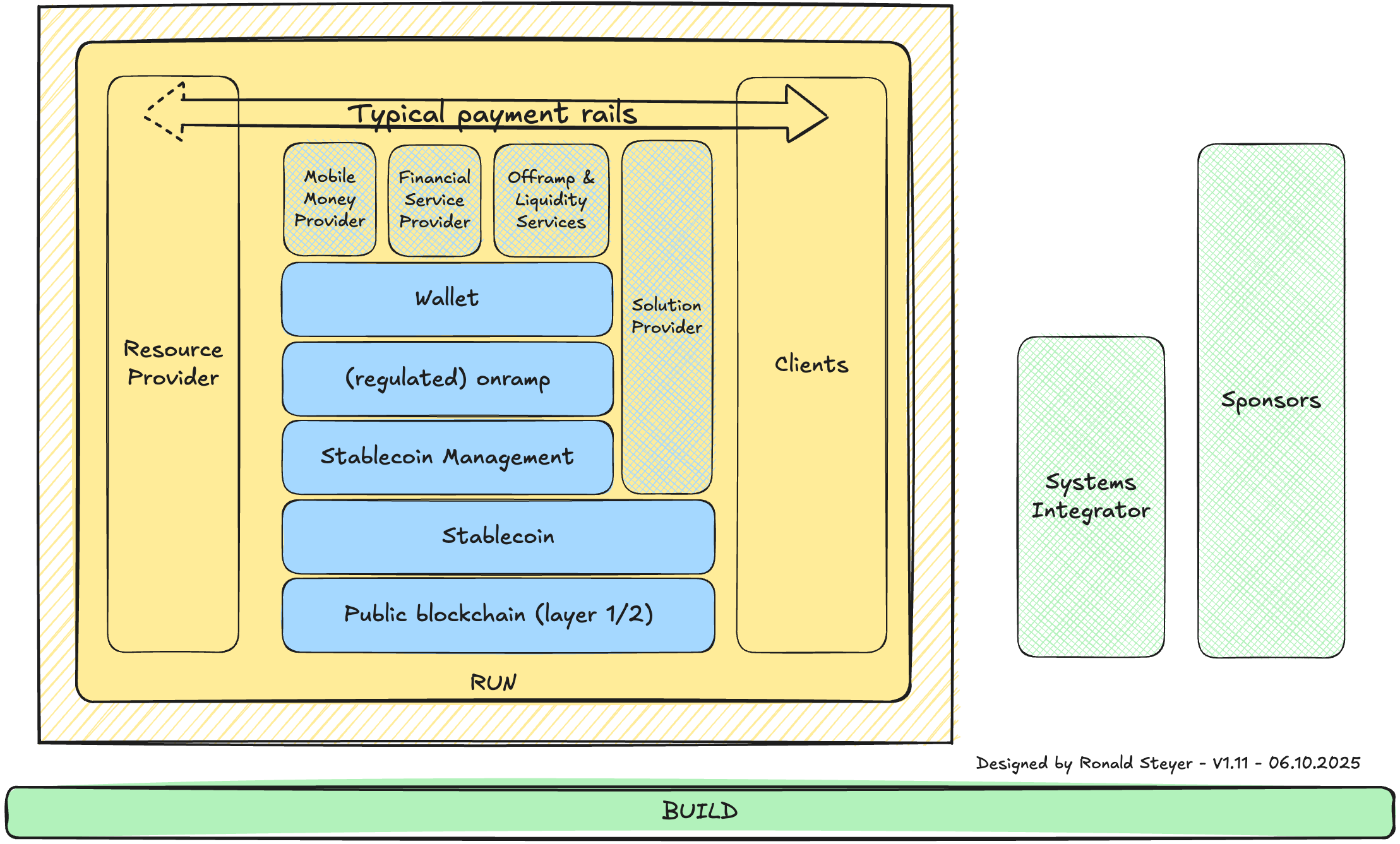
Before any transaction takes place, it’s crucial for interested parties to collaborate, and especially involve the clients, to create and implement the necessary system.
Clients are the recipients in this system, and they must rely on it to receive funds securely and efficiently. These clients can be individuals, small business owners, local non-governmental organisations (NGOs) or communities in need. Their ability to access and use the system directly impacts its success. Ensuring that the technology is intuitive, reliable, secure and accessible—even in fragile and low-connectivity environments—is essential to meeting their needs and empowering them with financial autonomy.
So the whole idea is to build payment rails between resource providers and clients. Resource providers—donors, UN agencies, and NGOs—supply the funding and political will that drive the project forward. Their commitment ensures that the system has the resources it needs to operate and grow.
Sponsors can play a critical role by providing strategic support, advocating for regulatory clarity and fostering ecosystem growth. Organisations such as the foundations of major Layer 1 blockchains often take on this role, offering technical expertise to help navigate this relatively new technology.
Depending on the complexity of the technical and non-technical solutions to be set up, Systems Integrators—much like in other IT projects—act as the architects who connect the dots. They take the raw potential of blockchain, stablecoins, and digital wallets, integrating them into established systems where needed to create a functional solution tailored to the needs of end users. Whether it’s an IT consultancy, a local tech partner, or a specialised firm, their job is to ensure that every piece fits together seamlessly.
Under the Hood: How the System Works
With these players neatly lined up in such a setting, we can now take a closer look at the solution and its technology stack. This will help us to understand the role of the different components of the technology and the services necessary to make the whole thing work.
At the foundation of the system is the public blockchain, the technical backbone that ensures transactions are secure, transparent, and tamper-proof. Networks such as Ethereum, Algorand, Polygon, or Stellar provide such technical platforms.
Building on these public blockchains, stablecoins offer users the digital means to transfer value digitally. They bridge the gap between technology and economics and serve as a reliable medium of exchange that protects users from the volatility often associated with cryptocurrencies.
For end-users—whether they’re small business owners, local NGOs, or individuals—digital wallets serve as the gateway to the system. These wallets are designed to be user-friendly, even in areas with limited connectivity, and provide a secure place to store and manage funds.
As this system relies on institutions usually providing non-crypto funds, it must be able to connect to traditional funds. Regulated on-ramp service providers make it possible to convert traditional currency into digital assets, ensuring liquidity and compliance.
Meanwhile, off-ramp services allow users to cash out when needed, bridging the gap between digital innovation and everyday reality. The options available here vary widely and depend on the situation, as well as the needs and preferences of the clients.
Now, solution providers are emerging that offer to connect all of this and provide it as a service. These fintech start-ups and specialised companies promise to design and customise the tech stack so that the system is functional, accessible and relevant in specific contexts and to the communities it serves.
A Call to Collaborate
This is mostly new territory for the sector, yet I see a lot of interest and activity, and many pilots of such solutions. Exchanging experience can help everyone involved to develop solutions that address the respective challenges and the perspectives and priorities of the clients.
If you are already working with or in this stack, do you see your role reflected in this model? How can we refine this approach to better describe what is needed to make it work for everyone involved?
The conversation obviously doesn’t end here. Let’s continue to explore, adapt and innovate together. After all, it’s not just about building a payment system — it’s about creating a tool that truly makes a difference.