⚠️ #PeakAid might be upon us — International Cooperation should shift focus towards investing in local power, sustainability, and resilience. #FutureOfCooperation
👉🏻 More on this in my blog, also on #transformation, #web3, and #AI.
⚠️ #PeakAid might be upon us — International Cooperation should shift focus towards investing in local power, sustainability, and resilience. #FutureOfCooperation
👉🏻 More on this in my blog, also on #transformation, #web3, and #AI.
The future of Germany’s Development Ministry (BMZ) is more uncertain than ever as discussions intensify about integrating its functions into the German Foreign Office (Auswärtiges Amt). As reported by Entwicklungspolitik Online, a German news platform for the international cooperation sector epo.
I wrote about what that might mean the other day, so have a look
#FutureOfCooperation
Full article in German: “Entwicklungspolitik: Die Zukunft des BMZ steht mehr denn je auf dem Spiel”
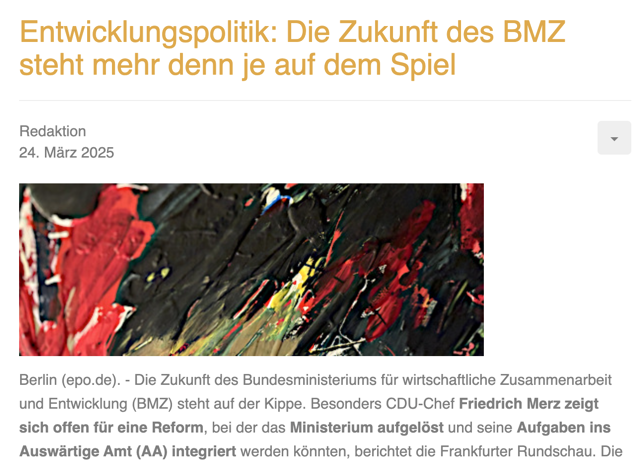
In the context of major disruptions in global government-funded #InternationalCooperation (aka development cooperation and development aid), it may be interesting to learn about developments in this area in #Germany after the elections.
From what I can see at the moment, there will most probably be some changes in international cooperation in Germany:
What could this mean? #FutureOfCooperation
With tighter budgets now imminent, development actors must urgently embrace innovation, such as leveraging digital technologies, fostering new partnership models, and implementing adaptive cooperation practices. The sector prioritized top-line funding figures, and this moment demands becoming obsessed with impact. It requires moving decisively beyond previous reluctance to address evident, long-standing challenges, aggressively reducing overhead, and genuinely prioritizing localization and locally-led solutions.
My experience working with the Foreign Ministry in development cooperation and nexus contexts has shown a pragmatic, results-driven approach, balancing clear expectations for impact with a realistic perspective. Their openness to innovative implementation models has been particularly valuable. If the ministry takes a leading role in the sector, this could signal a recalibration—potentially shifting towards more short-term, pragmatic approaches aligned with explicitly foreign policy-driven projects.
Follow my blog for more on these topics: Transformation - web3 - AI - International Cooperation.

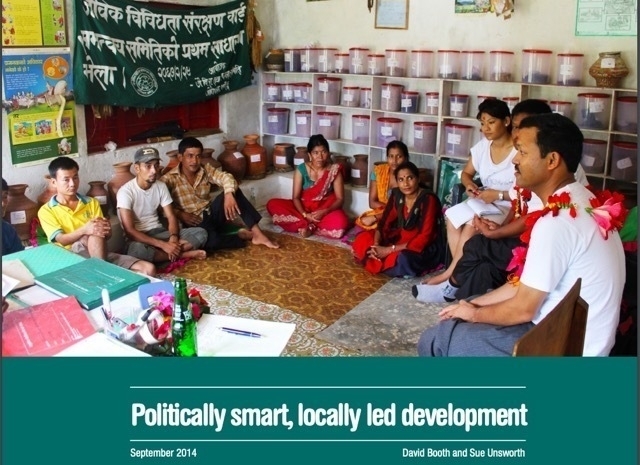
A Decade of Overdue Change - Embracing Politically Smart, Locally Led Development: More than 10 years ago, David Booth and Sue Unsworth challenged conventional donor practices in their paper Politically smart, locally led development. Their insights remain critical today, calling for a shift towards more adaptive and locally empowered approaches. #FutureOfCooperation
Key Insights:
Despite being over a decade old, the paper’s call for critical reflection and innovation remains unheard in mainstream development practice. It’s time for transformative change that truly empowers local communities.
Source: David Booth and Sue Unsworth 2014
🌍✨📌 This post of Marina Kobzeva about “humanitarian sector’s best-kept secret” gives a personal and at the same time very analytical perspective on an often overlooked aspect of #InternationalCooperation: the crucial role of those traditionally referred to as “local staff”.
Full post on LinkedIn: www.linkedin.com/feed/upda… Marina Kobzeva @ LinkedIn: www.linkedin.com/in/marina…
First, the term ‘local staff’: As described in the post, this too often implies lower visibility or status. More of a ‘helper’ than a key enabler. So what makes local staff ‘local’? Even HQ staff are local somewhere. So the baseline should be to recognise those colleagues in a global company or institution who play a critical role, and to respond to the costs they bear.
Let’s go one step further: What if, for a moment, we forgot the traditional system of well-meaning outsiders and instead built the whole system around these critical colleagues? Imagine a coaching team, like a soccer team, working for the success of its professionals.
For success it needs responsibility and professionalism in a balanced system that, in its own interest, respects the special role of the colleagues working in the cooperation country. This requires serious reflection. Innovative support systems can help to move from insight to real change.
🤝🌍 #FutureOfCooperation
This call for direct investment in national leaders is clear: the aid system must shift from a top-down, donor-driven approach to inclusive, locally-led development that puts community voices at the centre. Donors need to fund big and fund local. #FutureOfCooperation
But even now, the established players do not seem too keen on change: Just recently, a leading German think tank suggested in a op-ed for the Fourth Financing for Development (FfD) Conference:
“Innovation may have to wait. For now, simply keeping multilateral efforts afloat may be the best possible outcome.”
So even now, the industry seems more concerned with its top line figures and maintaining its structures than with the structural challenges it has been put off for too long already. A lot of work required for positive change!
Full post by TalkToLoop: t1p.de/dalb0
TalkToLoop on LinkedIn: t1p.de/q3swk
Op-ed of German think tank IDOS: t1p.de/dshow
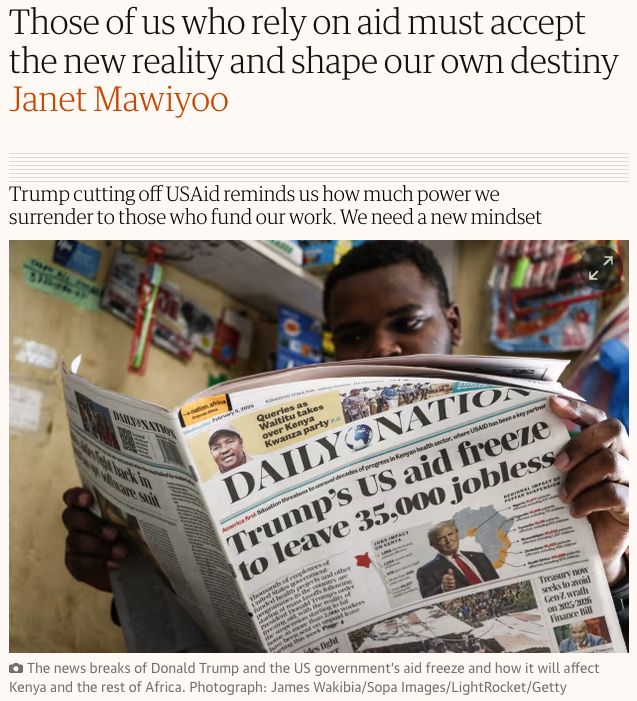
Janet Mawiyoo’s article is a timely call for reflection. She insightfully reflects on the changing landscape of international aid and urges communities to embrace self-reliance. Whatever role international cooperation can play in this, it should always and truly be the starting point for international partners in the future. #FutureOfCooperation
Full article in The Guardian: t1p.de/iybcc Janet Mawiyoo on LinkedIn: www.linkedin.com/in/jmawiy…
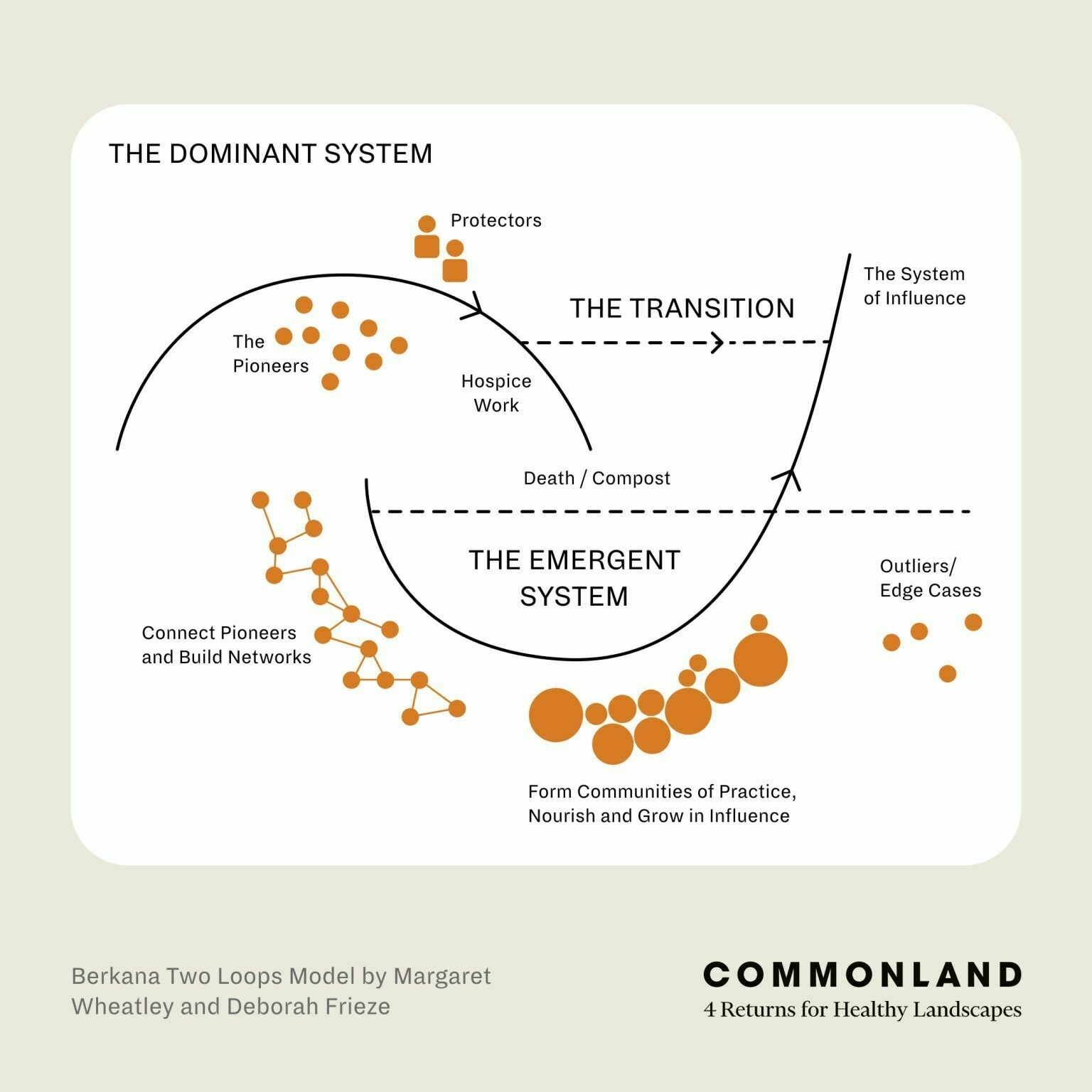
Nice visualisation of a transformation journey shared by the people of Commonland 👉 commonland.com.
Thanks to Jeremy Akers for sharing this! 👉 Jeremy Akers
It’s a stark reminder for those innovating in the global aid industry: the old system - with its vested interests - won’t just let go, even when it’s under considerable pressure. Instead, a powerful dynamic driven by positive energy needs to be created. ⚡
#FutureOfCooperation
Here’s how the change is being driven:
What I am personally taking away from this for my journey:
So, if you’re interested, get in touch and let’s collaborate! 🚀
Learned about a very interesting concept of running localisation labs to introduce experimentation into the work of local actors and local NGOs. #FutureOfCooperation
Understanding that the #DevelopmentAid #HumanitarianAid industry needs to change is one thing. But it needs alternatives: One interesting approach is NEAR’s localisation labs: Launched in 2023, they empower local leaders and organisations to drive localisation by building connections and advancing shared goals through four pillars: amplifying voices, positioning local leaders, co-creating solutions, and fostering learning.
Also check out NEAR (Network for Empowered Aid Response), a movement of local and national civil society organizations from the Global South, aiming to reshape the humanitarian and development aid system into one that is locally driven, equitable, and dignified.

While claiming to address “The Elephants in the Room: Uncomfortable Perspectives on the Fourth Financing for Development (FfD) Conference” the author of the op-ed avoids confronting the real challenges of development cooperation—even arguing that ‘Innovation may have to wait.’
But can a system that has spent decades evolving into a self-referential sphere afford to delay meaningful transformation?
Despite its self-perception, the development industry has become well-funded but also rife with self-referentiality over its decades-long history as a policy field and industry. It has become highly complex, expert-driven and increasingly disconnected from both those it seeks to serve and those who ultimately fund its initiatives. As the field has evolved, it has lost sight of the fundamental that international cooperation, at its core, must be about people — thinking, reflecting, and acting for change. So, has the development industry forgotten that it is a people business?
In OECD countries development policy has long remained a niche interest. Public engagement was limited, allowing the sector to grow into a quite siloed ecosystem, without being subject to broader and more intensive social scrutiny.
Yet, skepticism was already present. Even before populist narratives gained traction, public confidence in development aid was low. In Germany, e.g., in 2017 only 10% of respondents to a survey thought it was largely effective (while 25% thought it was mainly ineffective). This sentiment did not lead to anything significant — perhaps because the system continued to function well for established players. But was it working well for the people it was meant to serve?
The sector’s top-down decision-making, rigidities, donor-driven priorities and lack of local ownership have often stifled local problem-solving and lasting positive transformation. While the humanitarian sector, for example, has addressed some of these issues through the Grand Bargain process, there has been little in the way of in-depth reactive efforts in development.
This is where innovation comes in. To move the sector forward, it must come to terms with its past. This is why the recent push by the German Federal Ministry for Economic Cooperation and Development (BMZ) to examine colonial continuities is a step forward. It would also be important to systematically increase the participation of local communities in projects. Innovative digital solutions can improve transparency, accountability and impact, while reducing the risk of corruption. To name but a few
Yet, the op-ed essentially advocates for preserving the status quo — suggesting that “Innovation may have to wait.”
So let’s address the elephant in the room. For too long, the industry has been caught in a cycle of self-reinforcement, not feeling the need for meaningful change even in the face of mounting internal and external challenges.
The question is no longer whether innovation is needed, but whether the key players have the courage to act before the industry loses even more of its reputation as a real contributor to solutions.
#FutureOfCooperation